

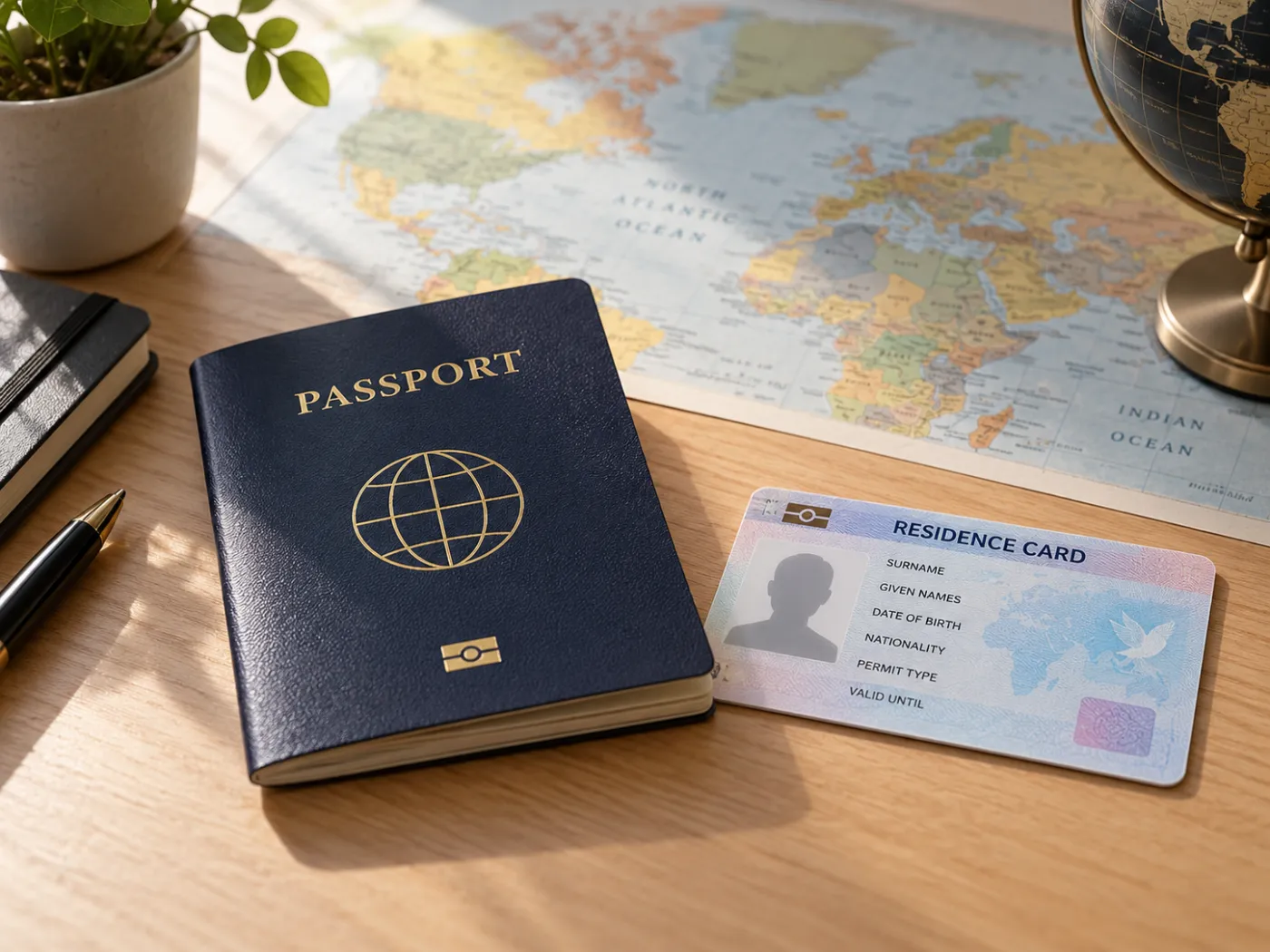
Residency vs citizenship by investment: what each really gives you, which goals need a passport, and the costly mistake of buying the wrong one.
Key takeaways
- A second passport doesn't change where you pay tax. Tax follows where you live, not your nationality.
- Most goals, including relocation, lower taxes, schooling and local banking, are solved by a residency rather than a citizenship.
- A passport is worth buying when your current nationality is the problem: travel restrictions, banking barriers or long-term political risk.
- Keeping a residence permit and becoming tax resident are two separate tests, with different day counts.
- Several European golden visas have closed since 2022, and several of those still open (as of October 2026) no longer accept a direct property purchase.
Ask a room full of successful entrepreneurs why they want a second passport, and two answers come up more than any others: to pay less tax, and to be free to live wherever they like. Both sound reasonable, and both rest on a misunderstanding. A passport from a Caribbean island doesn't change where you're taxed, and it gives you no more right to settle in Lisbon or Dubai than the passport you already hold. Choosing between residency vs citizenship by investment is mostly a matter of pulling apart three things people tend to bundle together: the right to live somewhere, the place where you're taxed, and the nationality printed on your travel document.
Below you'll find what each route actually gives you, which goals call for which instrument, the residency programmes still open as of October 2026, and the two mistakes that tend to cost the most. If you're still weighing whether a second nationality is something you need at all, our overview of the four routes to a second citizenship covers the broader picture.
What is the difference between residency and citizenship by investment?
Residency by investment gives you the legal right to live in a country, while citizenship by investment makes you a national of that country, with a passport of your own.
A residence permit is a conditional status. You hold it as long as you keep the qualifying investment, renew on time and, in some programmes, spend a minimum number of days in the country. In return, you can live there, register an address, enrol your children in local schools, and open bank accounts that are often closed to non-residents. If you genuinely move your life there, a residency can also become the basis for tax residency, which is where the financial effect usually lies.
Citizenship works on a different level. It gives you a second passport, visa-free travel to whichever countries accept that passport, and a status that doesn't need renewing. Once granted, it's generally permanent and can often be passed on to children, depending on the issuing country's nationality law. What it doesn't do is give you any right to live in a third country, and it does nothing to your tax position if you carry on living where you live today.
In practice, most people who buy a citizenship by investment never intend to live in the country that issued it. A residency, by contrast, is usually bought precisely because you want to be somewhere, or at least to have the option.
Does a second passport lower your taxes?
Almost never on its own, because nearly every country taxes individuals based on where they live, not on which passport they hold.
Your personal tax residency is decided by facts on the ground: how many days you spend in a country, where your permanent home is, where your family lives and where your economic interests sit. As long as those facts point to your home country, its tax authority will keep treating you as resident and taxing your worldwide income, whatever passport you show at the border. The United States is the well-known exception, because it taxes its citizens wherever they live. That makes a US passport the rare case where nationality makes your tax position heavier, not lighter.
Tax authorities and banks are also well aware of the misconception. In October 2018 the OECD published an analysis of more than 100 residence and citizenship by investment schemes, flagged those it considered high-risk for avoiding automatic exchange of financial account information (the Common Reporting Standard, or CRS), and gave financial institutions guidance on the follow-up questions to ask when a client's claimed tax residence looks doubtful. In practice, presenting a new passport to your bank doesn't redirect where your account data is reported. If anything, it can trigger more questions.
So if lower taxes are the goal, you're looking at a residency question. You need to move, become tax resident somewhere else and leave your home system properly, which in some countries includes an exit tax on company shares. A passport plays no part in that.
Do I need a second passport or residency?
For most goals a residency is enough, and a passport only becomes necessary when the problem is your current nationality itself.
The table below starts from what you're trying to achieve rather than from the product. It's deliberately simplified, but it covers the motivations that come up most often.
| Your goal | Does a residency solve it? | Does a citizenship solve it? | What actually decides it |
|---|---|---|---|
| A Plan B if things change at home | Usually, as long as you keep the permit valid | Yes, permanently, but only for the issuing country | Where you would really want to live in a crisis |
| Lower personal taxes | Yes, if you move and become tax resident there | No, not on its own | Physical presence and properly leaving your home tax system |
| Access to banking | Often, for local banking (many UAE banks open personal accounts only for residents) | Helps when your current nationality is the barrier | How banks' compliance teams view your nationality and residence |
| Travel freedom | Partly. An EU permit allows short stays across Schengen (90 days in any 180) | Yes | The passport's visa-free list, and how stable it is |
| Schooling for your children | Yes | Not needed | Residence in the country where the school is |
| Protection against political risk at home | Partly, it gives you somewhere to go | Most strongly, as the second nationality is outside your home country's control | Whether the risk concerns your passport, your assets or your freedom to leave |
| Something to pass to the next generation | Rarely, permits are personal and conditional | Often, through citizenship by descent | The issuing country's nationality law |
Read down the middle column and you'll notice how often a residency is the more precise tool. Citizenship wins clearly when you need to travel without visa applications or when your current nationality closes doors at banks and borders, and it has an edge if you're planning for your children. Outside those cases, buying a passport often means paying for something you won't use.
Where can you still get residency by investment?
As of October 2026, the main options are the UAE Golden Visa and a shrinking group of European programmes, several of which no longer accept a straightforward property purchase.
The UAE Golden Visa
The UAE Golden Visa is a long-term, self-sponsored residence visa, renewable as long as you still qualify. The best-known route is property: a title deed value of at least AED 2 million, which carries a ten-year renewable permit. Other routes cover capital investment of the same amount (deposits, funds or company ownership), entrepreneurs, and skilled professionals with a basic salary of at least AED 30,000 a month. A mortgage on the property doesn't rule you out, and off-plan units can count too, provided the registered value reaches the threshold and your bank has no objection to a residence permit being issued.
Two features matter for this comparison. Golden Visa holders can sponsor their spouse and children, and they're exempt from the usual rule that a UAE residence visa lapses after more than six months abroad. That makes it attractive as a Plan B residency. It also creates the trap we come back to below, because holding the visa says nothing about whether you're UAE tax resident.
European residency programmes still open
The European options look quite different from five years ago. Here is the status as of October 2026, based on the most recent official and legal sources available:
| Country | Main route and minimum | Minimum stay to keep the permit | Worth knowing |
|---|---|---|---|
| Greece | Property from €800,000 (Attica, Thessaloniki, Mykonos, Santorini, larger islands) or €400,000 elsewhere; €250,000 only for change-of-use or listed-building restoration | None | Five-year renewable permit; at the €800,000 and €400,000 levels the investment must be a single property of at least 120 m², and the property may not be let short-term |
| Portugal | €500,000 in a qualifying investment fund, plus research, cultural and job-creation routes; property no longer qualifies | 7 days in the first year, then 14 days in each two-year period | Naturalisation now needs 10 years of legal residence for most nationalities |
| Malta | Permanent residence with a property purchase from €375,000 or a lease from €14,000 a year, plus government fees and contributions and a capital test | No minimum stay | Permanent status from the start, monitored for five years |
| Italy | €250,000 in an innovative start-up, €500,000 in an Italian company, €2 million in government bonds or a €1 million donation; property doesn't qualify | Not specified for the investor permit | Two-year permit, renewable for three years if the investment is maintained |
| Hungary | €250,000 in an approved real estate fund, held for five years | None | Ten-year permit; the programme's future after the 2026 change of government is unclear |
| Cyprus | €300,000 in property, a Cypriot company or approved funds, plus a minimum foreign income | One visit every two years | Permanent residence, but Cyprus isn't yet part of Schengen |
Which European golden visas have closed?
Since 2022, four programmes have closed to new applicants. The UK shut its Tier 1 investor visa in February 2022, Ireland ended its Immigrant Investor Programme in February 2023, the Netherlands abolished its investor permit in April 2024, and Spain stopped accepting golden visa applications on 3 April 2025. Portugal didn't close, but it removed real estate as a qualifying route and has since lengthened its path to citizenship.
In each case, people already holding a permit kept their rights, and pending applications were generally processed under the old rules. A closure rarely hurts existing holders, but you can't count on a route still being there when you finally decide.
Golden visa vs citizenship by investment: what do you have to do after approval?
With a golden visa, your obligations continue after approval; with citizenship, they mostly end there.
This is where many people stop reading the rules too early. A residency comes with two separate day counts that have nothing to do with each other. The first is what you need to keep the permit alive. For the UAE Golden Visa, Greece, Malta and Hungary, that's effectively nothing. Portugal asks for 7 days in the first year and 14 days in each two-year period after that. The second count is what you need to become tax resident, and that is a much higher bar.
In the UAE, under Cabinet Decision No. 85 of 2022 (in force since 1 March 2023), you're tax resident if your usual place of residence and centre of financial and personal interests are in the UAE, or if you spend at least 183 days there in a 12-month period. A shorter test of 90 days applies to UAE residence permit holders who also have a permanent place of residence in the UAE or carry on employment or a business there. Fall short of these, and you hold a valid Golden Visa while remaining fully tax resident wherever you actually spend your time.
If your longer-term aim is an EU passport through residency, the presence rules get stricter still. Portugal's new nationality law, in force since 19 May 2026, requires 10 years of legal residence for most non-EU nationals, counted from the date the first residence permit is issued rather than from the application date. Hungary expects eight years of continuous residence and a language exam, and Cyprus counts real residence rather than occasional visits. The idea that a golden visa with a week of presence a year leads quietly to a European passport is, for most programmes, out of date.
Citizenship by investment has none of this. Once the passport is issued, there are no day counts and no renewals. The trade-off is that the passport's value isn't fixed. In July 2023 the UK introduced visa requirements for citizens of Dominica and Vanuatu, citing concerns about their citizenship by investment schemes, and in December 2024 the EU Council permanently revoked Vanuatu's visa-free access to the Schengen area for the same reason, having already suspended it in 2022. The status is permanent, but the doors it opens can close.
What is the most expensive mistake people make?
The most expensive mistake is buying a citizenship for a problem that needed a tax residency, closely followed by getting a residency without understanding the presence rules that make it work.
The passport that changed nothing
The following example shows how Jonas runs a profitable consultancy and lives in a Western European country with a top income tax rate in the mid-forties. Frustrated by the tax burden, he spends a six-figure sum on a Caribbean citizenship, goes through months of due diligence and receives his passport. His family home, his children's school and his company's office stay where they are, and he spends over 200 days a year there.
Nothing about his tax position has changed. His home country still treats him as resident and taxes his worldwide income. When his bank sees the new passport, its compliance team asks why he's suddenly presenting a nationality with no connection to his life. Two years on, he's paying the same tax as before, minus the cost of the passport.
What Jonas needed was a different sequence entirely: a residence where he actually intends to live, enough real presence there to become tax resident, and a properly planned exit from his home system, including checking whether his company shares would trigger an exit tax on departure. If he had done that, the passport would have been optional, and possibly unnecessary.
The mirror-image mistake
The second mistake runs the other way. Picture a professional who buys a property in Dubai worth just over AED 2 million, receives her Golden Visa and assumes she's now UAE tax resident. She keeps living mainly in her home country and spends around 60 days a year in Dubai. She doesn't meet the 183-day test, she falls short of the 90-day test, and her centre of life is clearly elsewhere, so she can't obtain a UAE tax residency certificate. Her home country, meanwhile, never stopped taxing her. The visa is valid and the property is hers, but the tax result she was counting on never existed.
Both mistakes come from treating a status document as if it settled the question of where you live.
When does it make sense to combine residency and citizenship?
Combining both makes sense when your goals sit on both sides of the table, typically when you need a new home base and your current nationality is also holding you back.
A common pattern is an entrepreneur who relocates to Dubai on a residency, becomes tax resident there and builds a company, but whose nationality makes travel slow or banking difficult. Holders of passports with limited visa-free access, or nationals of countries facing sanctions or heavy compliance scrutiny, often find that a UAE residency solves where they live while their passport still closes doors at banks and borders. In that case, the residency handles daily life and tax, and the second passport handles mobility and banking acceptance.
Families thinking in generations are the other group. A residency covers the present, including schooling and a stable base, while a citizenship that can pass to children by descent is a longer-term asset.
The order matters. In most cases the residency and tax residency question should be settled first, because it decides where you live and what you pay. The passport comes second, once you know which specific problem it has to solve. Before you apply for any second nationality, check whether your current country allows dual citizenship. Some withdraw your original nationality when you voluntarily acquire another, and that's an expensive surprise to discover after the fact.
When we work through these situations at GWS, the residency, the tax residency and the banking set-up are looked at together, because a decision in one of them almost always changes the others.
Who this is for, and who it isn't for
This article is most useful if you're an entrepreneur, investor or high-earning professional who is seriously considering a relocation, a Plan B or a second passport, and you haven't yet decided which instrument fits. It's also relevant if you already hold a golden visa and aren't sure it has done what you expected for your taxes.
It's less relevant if your motivation is purely travel convenience on a strong passport you already hold, as the gain from a second one may be small. It also isn't a guide to a specific programme's application process, and it can't replace tax advice in your home country, where the rules on leaving and on exit taxes vary considerably.
Conclusion
The choice between residency and citizenship by investment becomes much simpler once you start from the goal. Moving your life, your tax base or your children's schooling to another country calls for a residency and, in most cases, genuine presence there. A passport becomes the right tool when your nationality itself is the obstacle, whether at borders and banks or for your children's future.
Before committing money to either, work out where you'll actually spend your time over the next few years and compare that honestly with the day counts each status requires. Then confirm what your home country does with your tax residency and your original nationality once you leave. When those answers are clear, the right instrument usually follows.
The second citizenship series
- Part 1: How to Get a Second Citizenship: The Four Routes Compared
- Part 2: Citizenship by Investment: Costs, Due Diligence and Risks
- Part 3: Residency vs Citizenship by Investment: Which Do You Need? (this article)
- Part 4: Dual Citizenship Rules: How You Can Lose Your First Passport
FAQ
Can a golden visa lead to citizenship?
Sometimes, but it takes real residence. Portugal now requires 10 years of legal residence for most non-EU nationals (since May 2026), and Hungary and Cyprus expect several years of actual residence plus other conditions.
Does citizenship by investment make me tax-free?
No. Your taxes depend on where you're tax resident, which follows where you live. A second passport doesn't change that, and US citizens remain taxable in the US wherever they live.
Is the UAE Golden Visa enough to become UAE tax resident?
Not on its own. You generally need to spend at least 183 days in the UAE in a 12-month period, or at least 90 days if you hold a residence permit and have a permanent home or business there, or have your centre of life in the UAE.
What happens to my residency if a golden visa programme closes?
In recent closures (UK, Ireland, the Netherlands and Spain), existing permit holders kept their rights and pending applications continued under the old rules. Future closures could differ, so check the transitional rules of your programme.
Want to know more?
If you'd like to work out whether your goals call for a residency, a second passport or both, you're welcome to book a call with our team.
Sources
- UAE Government portal, Golden visa: https://u.ae/en/information-and-services/visa-and-emirates-id/residence-visas/golden-visa
- Dubai Land Department, Golden Visa application – Investor: https://dubailand.gov.ae/en/eservices/request-for-golden-visa-investor/
- Crowe UAE, The new UAE tax residency rules (Cabinet Decision No. 85 of 2022): https://crowe.com/ae/news/the-new-uae-tax-residency-rules
- EY, UAE guidance on determination of tax residency for individuals: https://www.ey.com/en_gl/technical/tax-alerts/uae-issues-additional-guidance-on-determination-of-tax-residency
- OECD, OECD clamps down on CRS avoidance through residence and citizenship by investment schemes (October 2018): https://search.oecd.org/tax/oecd-clamps-down-on-crs-avoidance-through-residence-and-citizenship-by-investment-schemes.htm
- International Bar Association, The Greek Golden Visa after the 2024–2026 overhaul (September 2026): https://www.ibanet.org/the-greek-golden-visa-after-2024-2026-overhaul
- Sovereign Group, Portugal brings new Nationality Law into force (June 2026): https://www.sovereigngroup.com/news/portugal-nationality-law-update/
- Migronis, Portugal Golden Visa in 2026: https://migronis.com/guides/portugal-golden/en/
- Mondaq, Malta Permanent Residence Programme (MPRP) 2026: https://www.mondaq.com/malta-permanent-residence-programme-(mprp)-2026-requirements-costs-timeline/1822054
- Frankvest, Italy's Investor Visa in 2026: https://www.frankvest.it.com/en/news/italy-investor-visa-foreign-investors-guide/
- Migronis, Hungary Golden Visa in 2026: https://migronis.com/guides/hungary/en/
- Migronis, Cyprus Permanent Residency in 2026: https://migronis.com/guides/cyprus/en/
- Spanish Government (ONE), Abolition of the investor visa in Spain: https://one.gob.es/en/contents/abolition-investor-visa-spain-and-its-implications
- Irish Legal News, Golden visa scheme scrapped (February 2023): https://www.irishlegal.com/articles/golden-visa-scheme-scrapped-with-almost-immediate-effect
- Lewis Silkin, Five countries added to UK visa national list (July 2023): https://www.lewissilkin.com/en/insights/2023/07/21/five-countries-added-to-uk-visa-national-list
- Council of the EU, Vanuatu: Council ends visa exemption (December 2024): https://www.consilium.europa.eu/en/press/press-releases/2024/12/12/vanuatu-council-ends-visa-exemption/
- IRS, U.S. citizens and resident aliens abroad: https://www.irs.gov/individuals/international-taxpayers/us-citizens-and-resident-aliens-abroad
About Global Wealth Strategy
Global Wealth Strategy (GWS) is an independent international advisory firm based at the Dubai World Trade Centre. Founded in Germany in 2018 and now headquartered in Dubai, GWS helps entrepreneurs, investors, high-net-worth individuals and families bring structure to their international lives: from company structuring and banking to asset protection, real estate, residency and succession. Every engagement starts with a clear roadmap across the areas that matter for the client, and GWS can implement it end to end. Our advisory is fee-based and independent, and we work alongside specialist legal and tax partners to turn complex cross-border situations into clear, coordinated strategies.
Disclaimer: This article is for general information only and does not constitute legal, tax or financial advice. Rules and requirements change, and outcomes depend on individual circumstances. Please seek qualified professional advice before acting.