

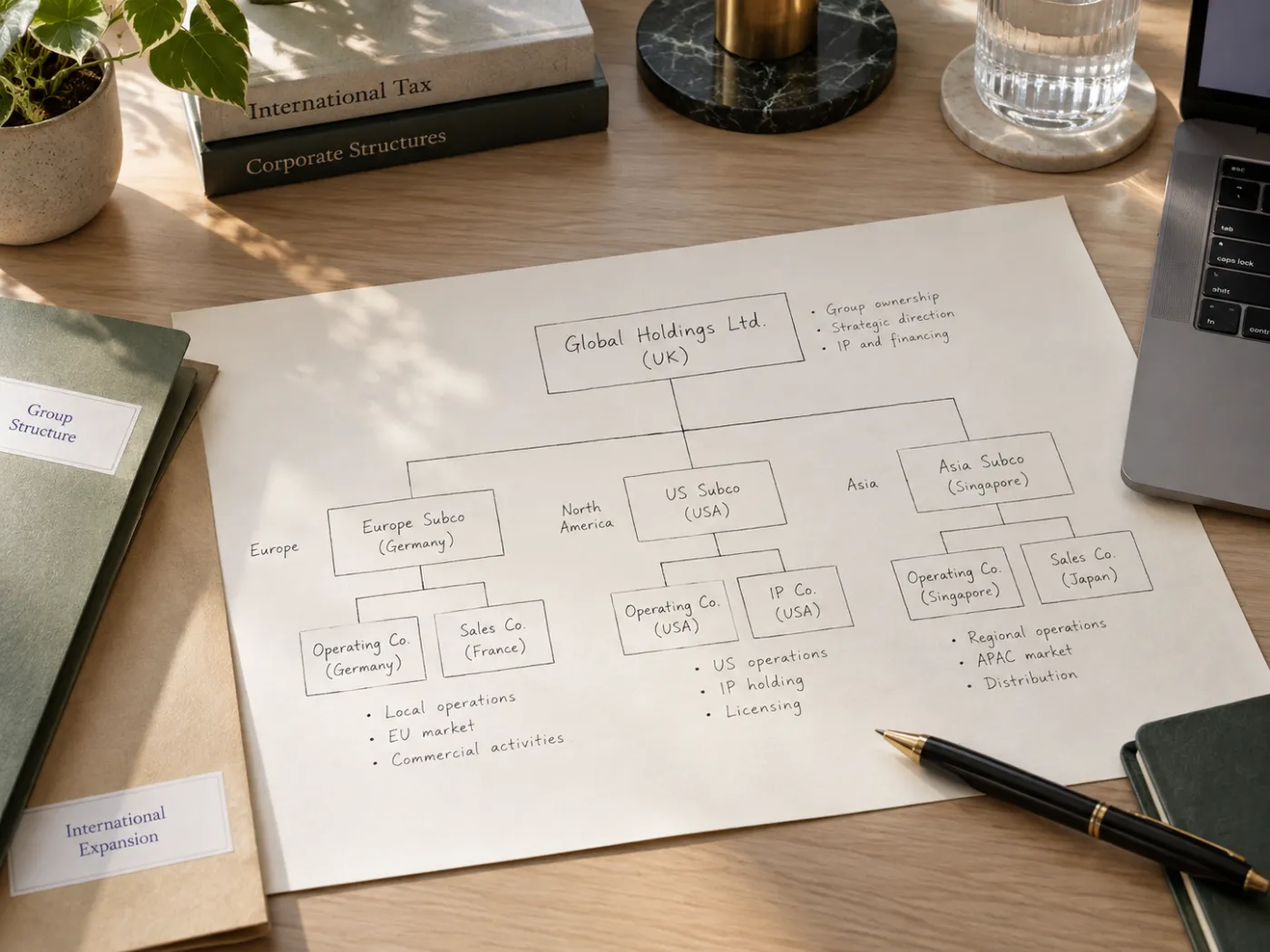
A micro family office applies family office principles with a small external team. What it is, how it is structured, what it costs and when it fits.
Key takeaways
- "Micro family office" is a way of organising wealth, not a legal or regulated status.
- It applies family office principles using external specialists instead of employed staff.
- The trigger is complexity across countries and entities, not a particular net worth figure.
- Strategy comes before structure; the expensive mistakes almost always happen the other way round.
- Cost is driven by the number of countries, entities and advisers involved, not by the size of the portfolio.
A client sits down and starts listing what he owns. An operating company in Germany. A holding company in the UAE that was set up three years ago because someone at a conference said it made sense. Two apartments in Spain, one of them still in his own name. Accounts at four banks across three countries. A tax adviser in Germany, another in Spain, a corporate services provider in Dubai who handles the licence renewal, and a lawyer he used once for a shareholder agreement and hasn't spoken to since. His daughter lives in Lisbon and has no idea what any of it is.
Each of those advisers is doing their job correctly. None of them has ever seen the whole picture, and neither has he.
That gap is what a micro family office is designed to close. This article explains what a micro family office actually is, how it is put together, who runs it, what it costs, and the situations where it genuinely helps rather than adding another layer of complication.
What is a micro family office?
A micro family office is a way of running family wealth that applies the working principles of a family office — strategy, legal structure, coordination between advisers, consolidated reporting and succession planning — through a small external team rather than employed in-house staff.
Before going further, one point that matters: "micro family office" is not a legal term, it carries no licence, and no regulator recognises it. You cannot register one. It describes how a family organises itself, in the same way that "head office" describes a function rather than a legal form. This is worth knowing because the words "family office" do carry regulatory meaning in some places. In the DIFC, for example, the Family Arrangements Regulations enacted in 2023 replaced the earlier Single Family Office regime and set out when registration and DFSA authorisation apply. A micro family office in the sense used here is none of those things. It is an operating model, and the structure underneath it is built from ordinary legal vehicles.
Single and multi-family offices sit at the larger end of the same idea, with employed teams and far higher fixed costs. We've written separately about how those models differ and what each one requires. The micro version keeps the logic and removes the payroll.
When does a micro family office make sense?
It makes sense when the complexity of your situation has outgrown the people managing it, which usually happens well before your wealth reaches the level people associate with family offices.
The signs are recognisable. You hold assets or companies in more than two countries. You have several banking relationships that don't know about each other. There are at least two advisers involved who have never spoken. A family member lives abroad, or will inherit something they have never been told about. A sale, a retirement or a generational handover is somewhere on the horizon. And most tellingly, decisions are being made one at a time, each sensible on its own, with no reference to a plan that covers all of them.
On net worth figures, honesty is more useful than a number. There is no credible published threshold for this model, because nobody collects data on something that isn't a legal category. What does exist is reliable data on the in-house version. The J.P. Morgan Private Bank 2026 Global Family Office Report, covering 333 family offices across 30 countries with an average family net worth of USD 1.6 billion, puts the average annual operating cost of a family office at USD 3 million, rising to USD 6.6 million for those managing over USD 1 billion, with 40% spending under USD 1 million a year. A long-standing rule of thumb in the industry, going back to a Credit Suisse white paper, is that a full-service family office costs at least USD 1 million a year to run, which implies a family needs somewhere between USD 100 million and USD 500 million for the model to be viable. That figure is dated and should be read as an order of magnitude rather than a benchmark, but the direction holds.
Which means the useful question isn't how much you have. It's whether anyone is currently responsible for the whole picture. Plenty of families at EUR 10 million are genuinely harder to manage than families at EUR 50 million, because the EUR 10 million is spread across six jurisdictions and the EUR 50 million sits in one company.
How is a micro family office structured, step by step?
It is built in layers, and the order matters more than any individual component. Each layer answers a question the previous one raised.
Strategy and roadmap
Everything starts here, and this is the step most often skipped. Before any entity is formed, you need clarity on what the wealth is actually for: who it has to support, over what period, what happens to the operating business, which risks you are genuinely exposed to and which ones you only worry about, and what the family wants to look like in fifteen years. This produces a written roadmap rather than a decision. Without it, every later choice is being made in the dark.
Legal structure
The structure follows from the strategy, not the other way round. In most cases this means separating assets from operating risk, typically by placing investments, property and participations under a holding company rather than leaving them inside the business or in personal names. Where succession or long-term protection is a real concern, a foundation or trust may sit above that holding layer. Jurisdiction depends on where the family lives, where the assets are and which treaties apply, and it is a question for qualified legal and tax specialists in each country involved.
Banking
Banking is set up deliberately rather than accumulated. The aim is a small number of relationships that each have a purpose, documented properly, with the paper trail that compliance departments will ask for. Families who have opened accounts opportunistically over fifteen years often discover during an audit or a succession that nobody can produce a clean record of where the money came from.
The external team and the coordinator
Specialists are retained where they are needed: a tax adviser in each relevant country, a lawyer for the structure, an accountant, and whoever handles property or corporate administration. One person or firm holds the overall picture, convenes the others, and makes sure that advice given in one country doesn't quietly break something in another. That coordinating role is what distinguishes a micro family office from a collection of advisers.
Protection and succession
This layer covers wills in each relevant jurisdiction, the mechanics of how shares and assets transfer, powers of attorney, and the practical question of who can access what if someone becomes ill or dies. In the UAE specifically, assets of people who die without a registered will can be frozen while local rules are applied, which is a problem no structure above it will solve.
Reporting and the annual review
Once a year, somebody puts everything on one page: entities, ownership, bank relationships, property, debts, and who is responsible for what. Then the roadmap is checked against reality. Laws change, families change, and a structure designed for a situation you no longer have is a liability.
| Layer | What it answers | Who typically handles it |
|---|---|---|
| Strategy and roadmap | What is this wealth for, and what are we protecting against? | The family, with the coordinating adviser |
| Legal structure | What holds what, and who owns it? | Lawyers, with tax input in each country |
| Banking | Where does money sit, and can we evidence it? | Coordinator, with the banks |
| Protection and succession | What happens when someone dies or falls ill? | Lawyers and notaries in each jurisdiction |
| Reporting and review | Is any of this still correct? | Coordinator, with accountants |
Who can set up and run a micro family office?
Three roles have to be filled, and they are rarely filled by the same person.
The first is the family member who takes ownership. Someone has to decide, sign and keep the thing alive, and delegating that entirely is how good structures quietly decay. The second is the coordinating adviser, who holds the overall view, keeps the roadmap current, briefs the specialists and makes sure nothing falls between two countries. The third is the specialists themselves, each responsible for correctness within their own jurisdiction and discipline, and none of them responsible for the whole.
This coordinating layer is where GWS works. We help families define the strategy and roadmap, design and set up the structure, and coordinate the legal, tax and banking partners involved so that the family deals with one point of contact rather than six.
What does a micro family office typically cost?
Published cost figures for this model should be treated carefully, because most of them come from firms selling the service rather than from independent research. What can be said with confidence is the comparison. The in-house model costs what the J.P. Morgan figures above describe, and PwC, which maps the different family office models, describes the single-family office as often the least cost-effective option and the virtual or outsourced model as potentially very cost-effective, because it replaces several salaried roles while the family keeps control.
What actually drives the bill is easier to pin down than a range. Each additional country adds a tax adviser, a filing obligation and a set of rules that have to be reconciled with the others. Each entity adds annual accounts, renewals and administration. Foundations and trusts carry set-up and ongoing trustee or council costs. Structures involving regulated activity cost considerably more than passive holding structures. The size of the portfolio barely matters; the number of moving parts matters enormously. A family with EUR 30 million in one holding company and one country will spend a fraction of what a family with EUR 8 million across five countries spends, and the second family needs the coordination more.
A realistic way to budget is to ask what you already pay. Most families who have accumulated advisers over a decade are surprised to find the total is not far from what a coordinated arrangement would cost. The difference is what they get for it.
What goes wrong most often?
The same four mistakes, in roughly this order of frequency and expense.
Building the structure before the strategy is the costliest. Someone forms a UAE holding company or a foundation because it was recommended, then spends the next two years working out what to put in it and whether it fits their actual circumstances. Unwinding a structure is far harder than not creating it, and in some cases triggers tax that forming it was meant to avoid.
Collecting advisers without coordinating them is the most common. Each gives correct advice within their own remit. Nobody checks whether the German adviser's recommendation survives contact with Spanish inheritance rules, and the family only finds out when it doesn't.
Copying a structure from another country is a quieter failure. A setup that works beautifully for a US family is frequently useless or actively harmful for a European one, because the controlled foreign company rules, exit taxation and treaty position are entirely different. Advice is specific to where you are tax resident, and tax residency is not the same thing as where you hold a visa.
Treating succession as something to handle later is the one that costs the next generation rather than you. Accounts freeze, assets get split in ways nobody intended, and the family spends years on something that a properly drafted set of wills would have resolved in weeks.
Who this is for, and who it isn't for
This model fits families whose affairs cross borders, who already work with several advisers, and who have reached the point where no single person knows what the whole picture looks like. It fits particularly well where a business sale, a relocation or a generational transfer is coming, because those events expose every weakness in a structure at once.
It isn't for everyone. If your wealth sits in one country, in one or two entities, with one tax adviser who understands all of it, you don't need this and adding it would be paying for coordination you don't require. It also isn't for anyone looking for a tax result in isolation. A structure built to produce one number tends to be fragile, and it ages badly. And if nobody in the family is willing to own the process, the roadmap will be written and then ignored, which is an expensive way to produce a document.
Conclusion
The decision in front of you is not really whether to call something a family office. It is whether the complexity you have built up over the last ten or fifteen years is being managed by anyone with sight of all of it, and what it would cost you if the answer is no. Those costs tend to arrive at the worst possible moments: during a sale, during a tax audit, or after a death, when the options that were available a year earlier have closed.
Start with the picture, not the paperwork. Write down what you own, where it sits, who advises on it and what you want it to do. If that exercise is uncomfortable, that discomfort is the useful information. Everything after it is detail, and detail can be arranged by specialists once somebody has decided what it is meant to achieve.
FAQ
Is a micro family office a legal structure?
No. It is a way of organising and managing wealth, not a legal form or a licence. The structures underneath it — holding companies, foundations, trusts — are ordinary legal vehicles, and they are what carry legal effect.
How to set up a micro family office, in practical terms?
Start with a written strategy covering goals, family circumstances, risks and succession. Then design the legal structure around it, arrange banking deliberately, appoint the specialists you need in each country, and put one coordinator in charge of the whole. Review it annually.
Do I need a family office if my wealth is under EUR 10 million?
Possibly, depending on how spread out it is. The practical trigger is complexity across countries, entities and advisers rather than a net worth figure. A simple EUR 20 million needs less coordination than a complicated EUR 5 million.
What is the difference between a micro family office structure and simply having good advisers?
The coordinator. Good advisers each solve their own part correctly; a micro family office makes someone responsible for whether the parts still fit together, and for keeping that view current as laws and family circumstances change.
Does a micro family office manage investments?
Not in the sense of making investment decisions for you. The model is about structure, coordination, reporting and succession. Investment management, where the family wants it, is a separate mandate handled by regulated firms.
Want to know more?
If you're weighing up whether your current setup still matches your situation, a conversation is usually the fastest way to find out. You can book a call here.
Sources
- J.P. Morgan Private Bank releases 2026 Global Family Office Report
- PwC: What type of family office is right for you
- DIFC announces enactment of the DIFC Family Arrangements Regulations No. 1/2023
- DIFC Single Family Office Regulations (official text)
- Investment Executive, summarising the Credit Suisse white paper on family office viability thresholds
About Global Wealth Strategy
Global Wealth Strategy (GWS) is an independent international advisory firm based at the Dubai World Trade Centre. Founded in Germany in 2018 and now headquartered in Dubai, GWS helps entrepreneurs, investors, high-net-worth individuals and families bring structure to their international lives: from company structuring and banking to asset protection, real estate, residency and succession. Every engagement starts with a clear roadmap across the areas that matter for the client, and GWS can implement it end to end. Our advisory is fee-based and independent, and we work alongside specialist legal and tax partners to turn complex cross-border situations into clear, coordinated strategies.
Disclaimer: This article is for general information only and does not constitute legal, tax or financial advice. Rules and requirements change, and outcomes depend on individual circumstances. Please seek qualified professional advice before acting.